

Why Does My Debit Card Keep Getting Hacked? 5 Hidden Culprits You Might Be Missing
If thieves compromised your debit card, you are not alone. The Federal Reserve’s 2026 Risk Officer Report found that 75% of financial institutions experienced debit fraud attempts, and that debit fraud accounted for an estimated 40% of total losses from payment fraud. Having your card compromised once feels like bad luck, but if it keeps happening, there may be a specific, fixable pattern behind it. Have you ever wondered why your debit card keeps getting hacked? If so, it may be time to take a closer look. If your card has not been compromised, it is still worth staying vigilant, since thieves are always looking for an opening. Here are five of the less obvious causes behind repeated debit card compromise.
Culprit One: Saved Card Details on Old Accounts
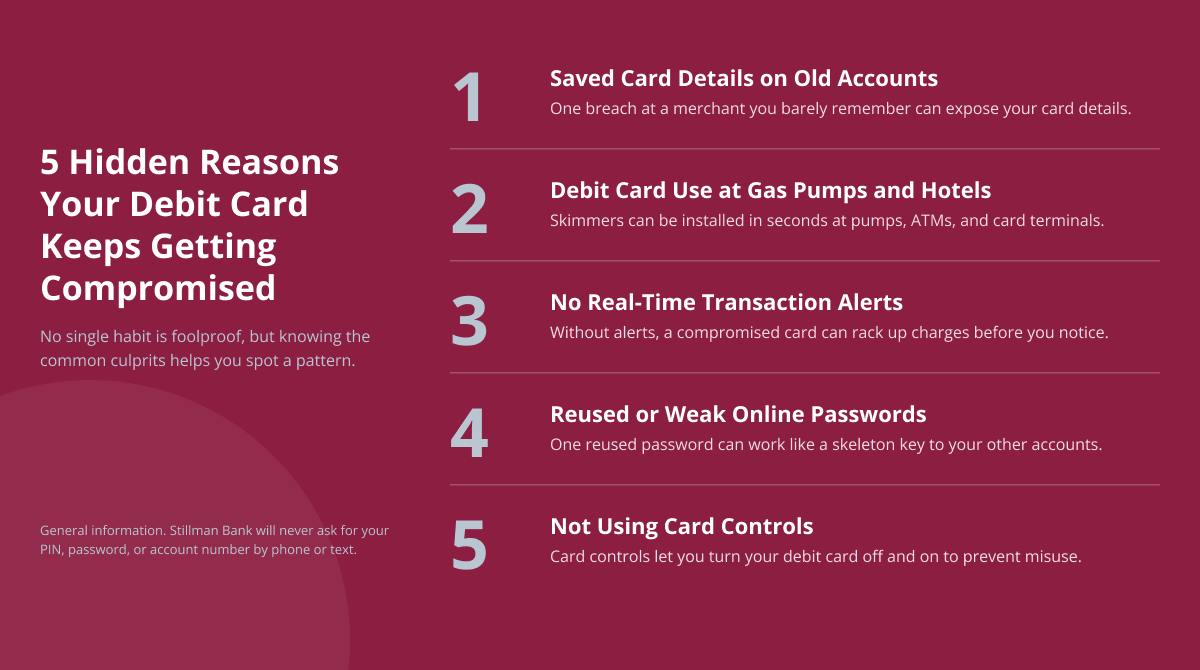
With so many subscription services, online stores, and apps linked to your debit card, it is easy to lose track of everywhere you have used it, and data breaches remain a persistent threat. Just one breach at a merchant you barely remember using can expose your card information without any mistake on your part. Companies are generally required to notify customers whose data was stolen or compromised, but if your contact information has changed since you last used a particular merchant, that notice may never reach you.
Culprit Two: Debit Card Use at Gas Pumps and Hotels
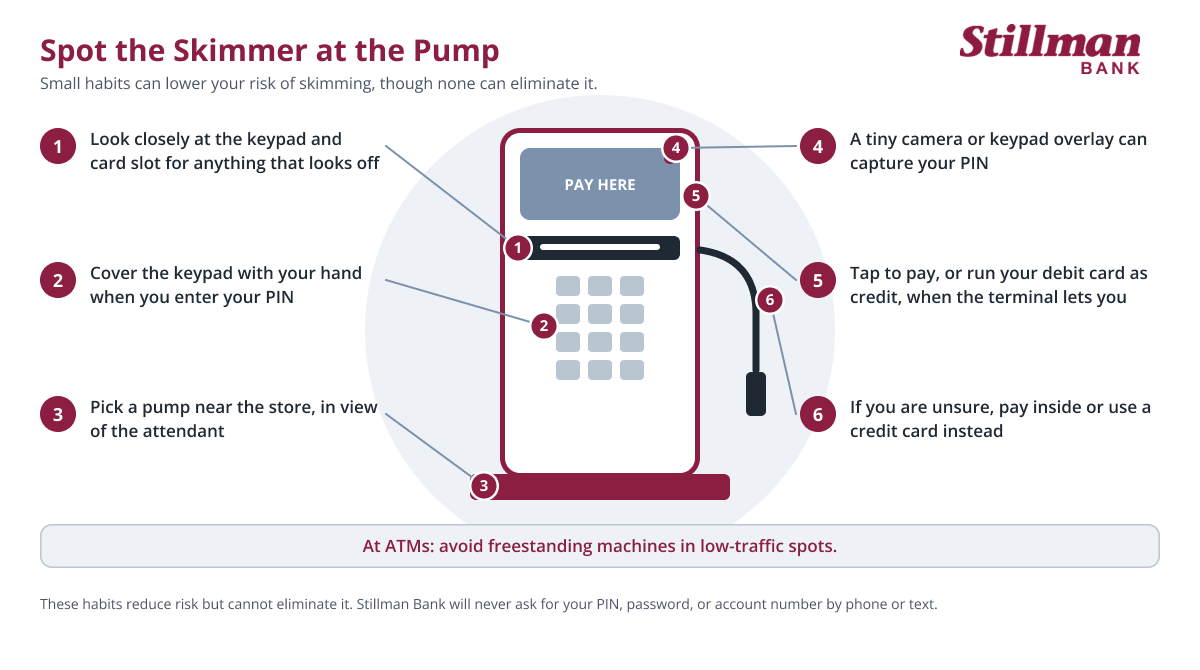
The FBI estimates that skimming costs American consumers and financial institutions more than $1 billion a year. Skimming happens when thieves tamper with ATMs and point-of-sale terminals to steal card information, usually in one of a few ways: installing a device inside the card reader, attaching a device on top of a legitimate terminal, or tapping into exposed cables. They may also use a small pinhole camera or a keypad overlay to capture a PIN as it is entered, then store the data for later retrieval or transmit it wirelessly to a nearby device. These devices can be installed in only seconds, so a common tactic is to distract a store clerk, such as asking a question that requires them to turn away from the terminal or step away from the register. This kind of scheme can happen at virtually any merchant, gas station, or ATM, though gas pumps remain a frequent target for both digital and physical skimming.
How to Avoid Debit Card Skimming
A few habits can meaningfully reduce your risk of debit card skimming, though none of them can eliminate it entirely:
- Choose a fuel pump closer to the store and within view of the attendant, which makes it harder for skimmers to go unnoticed.
- Terminals often let you run a debit card as either debit or credit. Where possible, run it as credit.
- Look closely at the terminal and keypad for anything unusual in the coloring, materials, or shape that might suggest a keypad overlay.
- Cover the keypad with your hand while entering your PIN, in case a hidden camera is recording.
- Consider paying for gas inside the store rather than at the pump, since the machine is harder to tamper with there.
- Tap your card whenever possible instead of inserting it. Tap-to-pay transactions are generally more secure.
- Avoid non-bank freestanding ATMs in convenience stores, bars, and hotel lobbies, especially standalone units in remote or low-traffic locations.
- If you are ever unsure whether a terminal is safe, use a credit card instead, since it typically carries stronger fraud protections.
Culprit Three: No Real-Time Transaction Alerts
Transaction alerts are one of the most effective tools for reducing your risk of debit card fraud. Without them, a compromised card can rack up several fraudulent charges before you notice. Enabling instant transaction notifications through our digital banking can help you catch fraud within minutes instead of days. Getting an alert every time you spend above a certain amount may feel like an inconvenience, but it is a small trade-off for being able to spot and stop fraud the moment it happens.
Culprit Four: Reused or Weak Online Banking Passwords
Every password should be easy for you to remember but hard for a thief to guess, and none of them should be reused across accounts. If criminals obtain one reused password, it can work like a skeleton key that opens the door to all of your other accounts, not just the one it was originally taken from.
Culprit Five: Not Using Card Controls
With active card controls through our online banking portal and mobile banking app, you can monitor your accounts in real time, initiate payments, use mobile check deposit, and set up balance and transaction alerts. You can also turn your debit card on and off to prevent misuse and notify us right away if it is lost or stolen. Card controls also let you block transactions with certain types of merchants or set up notifications for particular kinds of activity. It is a genuinely useful tool that most cardholders do not turn on until after a problem has already happened, rather than before.
Protect Your Debit Card from Being Compromised
If your debit card has been compromised more than once, it is likely part of a pattern rather than a run of bad luck. If your card has not been compromised, it is still worth thinking through how to protect it going forward. None of the methods above are completely foolproof, so staying vigilant matters just as much as any single step. Also remember that Stillman Bank will never ask for your PIN, password, or account number by phone or text. To reduce your risk of debit card fraud, turn on transaction alerts and card controls through our digital banking platform or mobile banking app. You can also check out our pages on reporting a lost or stolen debit card, fraud prevention, and Your Top Questions About Fraud, Answered. If you have any questions, please contact us or visit one of our six locations across northern Illinois. We are here to help you protect your accounts.